
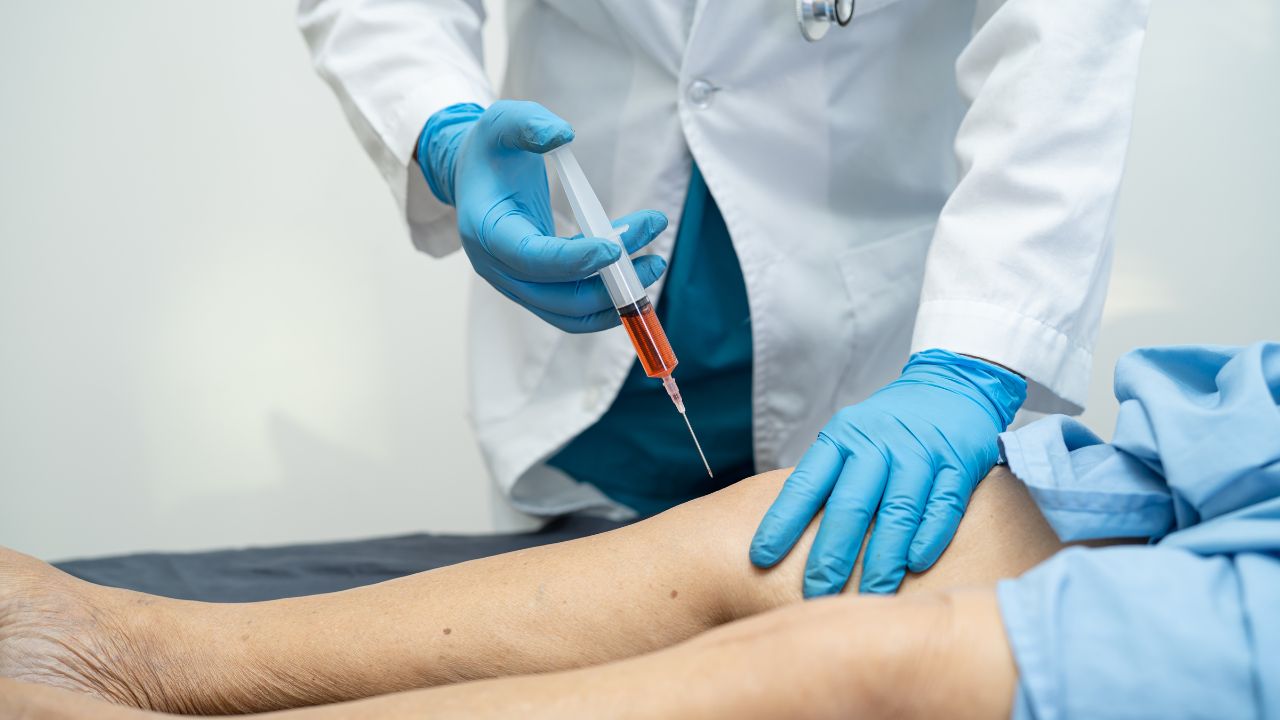
PRP vs. surgery is one of the most common decisions facing patients with chronic joint or tendon pain. Platelet-rich plasma and surgical repair both play important roles in orthopedic care, but they address different stages of tissue damage. The right choice depends on diagnosis severity, treatment goals, recovery burden, and realistic outcome expectations, not on preference alone.
Below, you’ll find a structured decision framework that compares how each treatment works, who qualifies, what recovery and costs look like, and what the research shows. It reflects the evaluation process used at the Regenerative Institute of Newport Beach when patients ask whether PRP injections can help them delay or avoid surgery.
Key Takeaways
- Consider PRP for selected tendon, ligament, and mild-to-moderate joint conditions where healthy tissue remains.
- Get a surgical evaluation for advanced structural damage, severe deformity, or end-stage joint disease when conservative care fails.
- Check the evidence for your specific diagnosis, since clinical guidelines show mixed recommendations for PRP by condition and preparation.
- Compare recovery time, insurance coverage, and out-of-pocket cost for PRP vs. surgery before you commit.
- Base your choice on a qualified evaluation that includes imaging, a functional assessment, and your response to prior treatment.
What Are PRP and Surgical Treatments for Joint and Tendon Pain?
PRP and surgery are distinct approaches with different mechanisms and indications. Knowing how each works sets realistic expectations for regenerative injections vs surgical intervention.
What Is Platelet-Rich Plasma (PRP) and How Does It Work?
Platelet-rich plasma uses a concentration of the patient’s own platelets, prepared from a blood draw and injected into the target area. A centrifuge spins the sample so the plasma holds more platelets than normal blood. Platelets carry growth factors involved in tissue healing, which is the scientific rationale for PRP in musculoskeletal care.
This biologic, injection-based approach is positioned as a non-surgical pain treatment choice in Newport Beach for selected tendon, ligament, muscle, and joint conditions.
PRP is not a single standardized product across all clinics and research studies. Preparations vary in platelet concentration, leukocyte content, activation method, and injection protocol, which contributes to variable outcomes.
What Surgical Options Are Common for Joint and Tendon Conditions?
Surgery can include arthroscopy, tendon repair, nerve decompression, partial or total joint replacement, and spine fusion depending on diagnosis. Each procedure aims to mechanically correct structural failure that biologic healing signals alone cannot resolve. The specific operation depends on imaging findings, deformity, functional loss, and prior treatment response.
Advanced bone-on-bone arthritis, full-thickness rotator cuff tears, and unstable spinal conditions often require surgical evaluation.
How Do PRP and Surgery Differ in Purpose and Mechanism?
PRP works through biologic signaling. It aims to reduce inflammation, support the body’s natural healing environment, and improve function in tissue that is still viable. Surgery works through direct anatomical correction: it repairs, reconstructs, decompresses, replaces, or stabilizes damaged structures that are unlikely to improve with conservative care.
PRP and surgery are not interchangeable long-term joint recovery options. They sit at different points on the disease severity spectrum and often play complementary roles, as the table below shows.
| Factor | PRP | Surgery |
|---|---|---|
| How it works | Growth factors from your own platelets signal repair | Mechanical repair, replacement, or stabilization |
| Typical candidates | Mild-to-moderate arthritis, partial tears, chronic tendinopathy | Bone-on-bone arthritis, full-thickness tears, instability, severe deformity |
| Setting | Outpatient office procedure | Hospital or surgery center with anesthesia |
| Downtime | Light activity right away; results build over weeks to months | Weeks to months; often 3 to 6 months for major repair or replacement |
| Main risks | Soreness, temporary flare, rare infection, no benefit | Anesthesia complications, infection, blood clots, nerve injury, failed healing |
| Insurance | Often paid out of pocket | More often covered when medically necessary |
| Main goal | Symptom relief and function preservation | Definitive structural correction |
Who Is a Candidate for PRP Versus Surgery?
Candidacy depends on diagnosis, imaging, disease stage, functional limits, and personal risk factors.
How Does Diagnosis and Disease Severity Influence Treatment Choice?
Osteoarthritis, rheumatoid arthritis, and post-traumatic arthritis are common causes of chronic joint pain. The degree of cartilage loss, bone deformity, and functional impairment decides whether conservative, regenerative, or surgical care fits. Early-stage conditions with preserved joint space may respond to regenerative approaches, while end-stage disease usually requires mechanical correction.
The treatment should match what the exam, X-ray, MRI, or ultrasound shows, not preference alone.
When Is PRP Appropriate Based on Tissue Type and Injury Stage?
Mild-to-moderate degenerative joint disease is a reasonable PRP target when joint space remains, and function is partly preserved. Partial tendon or ligament injuries, chronic tendinopathy, and selected sports injuries also fall within the scope of PRP therapy when tissue continuity remains intact. PRP may help where inflammation and incomplete repair dominate, rather than complete structural failure.
The strongest candidates have preserved tissue architecture, minimal deformity, and tissue that can respond to growth factor signaling. Patients with advanced bone changes or full-thickness tears are generally poor candidates for PRP as a primary treatment.
When Does Surgery Become Medically Necessary?
Surgery typically enters the discussion for advanced bone-on-bone arthritis after conservative and regenerative options fail to preserve function. Major joint deformity, severe loss of motion, and mechanical instability often exceed what injection therapy can address. Full-thickness tears with functional loss and unstable fractures are cases where surgical intervention may be medically necessary.
Delaying needed surgery in these cases can lead to worsening deformity, muscle atrophy, and secondary joint damage. A qualified orthopedic evaluation clarifies when surgery is the only reasonable path to pain relief and function. The table below shows how common findings point toward one path or the other.
| Clinical Finding | Leans Toward PRP | Leans Toward Surgery |
|---|---|---|
| Joint space | Preserved on X-ray | Bone-on-bone contact |
| Tendon or ligament | Partial tear or tendinopathy | Full-thickness tear with weakness |
| Joint stability | Stable joint | Mechanical instability or locking |
| Deformity | Minimal | Severe or progressive |
| Prior care | Non-surgical options not yet exhausted | Conservative and injection care have failed |
| Medical risk | High surgical risk or wants to avoid anesthesia | Healthy enough for surgery and rehabilitation |
What Are the Goals of Care With PRP Compared to Surgery?
Regenerative and surgical care aim at different goals, and misaligned expectations cause dissatisfaction even when a procedure succeeds.
How Does PRP Aim to Support Healing and Symptom Relief?
PRP aims to reduce pain, improve function, support the tissue healing environment, and in selected cases delay more invasive care. It does not rebuild anatomy or replace lost cartilage. Instead, it calms inflammation and stimulates repair pathways.
Improvement is gradual, over weeks to months, and often requires activity modification and rehabilitation. PRP fits when the goal is symptom control and function preservation rather than anatomical reconstruction.
How Does Surgery Address Structural and Functional Problems?
Surgery aims for definitive correction of deformity, instability, or failed tissue that cannot heal on its own. Outcomes depend on the procedure type, overall health, and adherence to rehabilitation.
Surgery offers more predictable structural correction than regenerative medicine, at the cost of greater invasiveness and a longer recovery.
How Should Patients Clarify Their Personal Treatment Goals?
Define your main priority: returning to work, resuming sports, golf or pickleball, beach and water activities, or caregiving. Activity demands and timelines shape whether a gradual regenerative approach or a definitive repair makes more sense. A patient who needs a fast return to high-impact sports may not do well with PRP alone.
Goals also include risk tolerance, recovery window, budget, and comfort with uncertainty. These factors shape the decision framework used to choose between conservative, regenerative, and surgical paths.
How Do Recovery, Risks, and Costs Compare Between PRP and Surgery?
Recovery, invasiveness, risk, and cost differ sharply between the two and often decide the final choice.
What Is the Typical Recovery Timeline and Invasiveness of Each Treatment?
PRP is an outpatient, minimally invasive procedure. Most patients return to light activity right away, though benefits build over weeks to months. Soreness or a short flare of symptoms is common in the first few days, and a structured rehabilitation plan supports healing.
Surgery may involve general or regional anesthesia, incisions, postoperative pain control, and physical therapy. Recovery timelines for joint replacement or major tendon repair often run three to six months before full function returns. Surgery can be more definitive for advanced structural conditions, but it demands a greater short-term sacrifice.
What Are the Common Risks Associated With PRP and With Surgical Procedures?
PRP risks include injection site soreness, a temporary pain flare, a small infection risk, and the possibility of no benefit. Because PRP uses your own blood, allergic reactions are rare, but outcomes vary by condition.
Surgery carries risks of anesthesia complications, infection, blood clots, nerve or vessel injury, hardware failure, prolonged pain, and failed healing. Risk rises with age, other medical conditions, smoking, and prior surgery at the same site. The FDA also warns consumers about unapproved regenerative medicine products, which is why a qualified medical evaluation matters for any option.
How Do Insurance Coverage and Out-of-Pocket Costs Impact Decision-Making?
Many insurers treat PRP as investigational for musculoskeletal conditions, so patients often pay out of pocket. Verify insurance coverage and payment options before starting, since costs range from hundreds to thousands of dollars per session and some plans call for more than one injection.
Surgery is more likely to be covered when medically necessary, but patients still face deductibles, copays, facility fees, anesthesia charges, and surgeon costs. Confirm exact costs and candidacy with the treating practice and your insurer before deciding.
What Evidence Supports PRP and Surgery for Joint and Tendon Conditions?
Evidence strength varies by condition, PRP preparation, and surgical procedure.
What Does Current Research Say About PRP’s Effectiveness by Condition?
PubMed indexes a steady flow of new systematic reviews and meta-analyses on PRP for knee osteoarthritis, a sign of active research. The American Academy of Orthopaedic Surgeons (AAOS) notes that PRP results depend on platelet concentration, leukocyte content, and injection technique. Scientific support varies by diagnosis and is stronger for certain tendon conditions than for advanced joint arthritis.
PRP is not a guaranteed substitute for joint replacement in bone-on-bone arthritis. Claims about PRP should be condition-specific, and PRP success rates by condition depend on patient selection and realistic expectations.
How Do Clinical Guidelines View PRP Versus Surgery for Osteoarthritis and Other Disorders?
The 2019 American College of Rheumatology and Arthritis Foundation guideline strongly recommends against PRP for knee or hip osteoarthritis. It cites differences between PRP preparations, a lack of standardization, and inconsistent evidence. This does not rule out PRP for every musculoskeletal condition, but it limits claims for knee and hip arthritis.
The 2021 AAOS knee osteoarthritis guideline is more cautious than negative: it states that PRP may reduce pain and improve function, based on limited-strength evidence. Surgical guidelines are condition-specific and depend on imaging severity, failed conservative care, and functional disability. The table below summarizes where the evidence stands.
| Condition | What the Evidence Shows for PRP | When Surgery Enters the Discussion |
|---|---|---|
| Chronic tendinopathy (such as tennis elbow) | More favorable support than for advanced arthritis | Rarely, after conservative and injection care fail |
| Mild-to-moderate knee osteoarthritis | Mixed: ACR/AF recommends against; AAOS says it may help (limited evidence) | Progressive cartilage loss with disabling pain |
| Hip osteoarthritis | ACR/AF recommends against | Advanced disease with loss of function |
| Partial tendon or ligament tears | Limited and variable evidence | Full-thickness tears, weakness, or failed rehabilitation |
| Bone-on-bone arthritis | Not a substitute for joint replacement | Joint replacement evaluation |
What Are the Limitations and Uncertainties in the Existing Evidence?
PRP is not standardized, so trial results do not transfer directly across clinics. Differences in platelet concentration, activation method, injection volume, and follow-up timing make studies hard to compare.
Current data do not support PRP as a universal replacement for surgery. Ask your clinician about the specific evidence for your diagnosis before choosing this path.
How Can Patient Values and Preferences Influence Treatment Choice?
Motivations, concerns, and misconceptions shape treatment choice as much as clinical findings.
What Motivations Lead Patients to Consider PRP or Surgery?
Many patients seek PRP to avoid or postpone major surgery, anesthesia risk, and long rehabilitation. Others want to cut back on pain medication or repeated corticosteroid injections that offer only short-term relief. Many patients choose PRP therapy to stay active at work, in sports, or with family without extended time away.
Patients pursue surgery when pain becomes intolerable, other treatments fail, or imaging shows damage that cannot heal without mechanical correction. The decision balances waiting too long against operating too soon.
What Common Concerns and Misconceptions Should Patients Address?
Some patients avoid PRP because they think it is experimental or not covered by insurance. The worry about paying out of pocket for an uncertain result is valid. Concern that delaying surgery could worsen a progressing deformity is also reasonable.
Fear of complications, anesthesia, opioids, and long rehabilitation pushes many patients toward regenerative medicine. Weigh that against the risk of undertreating an advanced structural problem.
What Questions Should Patients Ask Their Doctor When Weighing Options?
Ask which diagnosis imaging and the exam have confirmed, and whether the problem is inflammatory, degenerative, a partial injury, or severe structural failure. Ask which conservative options have already been tried.
Finally, ask whether the main goal is pain control, functional return, postponing surgery, or definitive repair. The answers show when PRP fits and when surgery does.
What Decision Framework Helps Patients Choose Between PRP and Surgery?
A structured framework weighs diagnosis, severity, goals, risks, recovery, and evidence to match treatment to need.
Which Factors Should Be Evaluated: Diagnosis, Severity, Goals, Risks, and Recovery?
The process starts with confirming the pain generator, the tissue involved, severity of damage, imaging findings, functional status, and response to prior treatment. A physical exam, imaging review, and medical risk screen should come before any treatment choice.
Recovery time, risk tolerance, insurance coverage, cost, and activity demands complete the picture.
When Might PRP Support Delaying or Avoiding Surgery?
PRP may help delay or avoid surgery in mild-to-moderate degenerative joint disease, chronic tendinopathy, and partial injuries such as some rotator cuff tears without complete structural failure. Patients who are poor surgical candidates, or who want a trial of non-invasive care first, may also benefit when diagnosis and severity align.
PRP is most defensible when imaging shows preserved tissue, as with certain meniscus tears treated without surgery, the patient accepts gradual improvement, and the goal is symptom control rather than reconstruction. Patients should also be willing to pursue surgery if regenerative care fails.
When Is It Important Not to Delay Surgical Evaluation?
Do not delay surgical evaluation for advanced joint degeneration, mechanical instability, full-thickness tears with functional loss, severe deformity, or disability that persists despite appropriate care.
Patients with progressive symptoms, shrinking range of motion, or trouble with daily activities should book a surgical consultation promptly.
PRP Vs. Surgery: Balancing Treatment Options for Long-Term Joint Recovery
PRP offers a minimally invasive option for selected patients with mild-to-moderate tissue damage, while surgery addresses advanced structural problems beyond the reach of regenerative medicine. Neither treatment is universally superior; each serves a distinct role in orthopedic care.
Base your decision on objective clinical findings rather than fear or preference alone. The Regenerative Institute of Newport Beach provides a thorough evaluation to help patients decide whether regenerative medicine, conservative care, or surgical referral fits their diagnosis and goals.
Schedule a PRP Evaluation at the Regenerative Institute of Newport Beach
If you are weighing PRP vs. surgery, a clear diagnosis is the first step. Dr. Khyber Zaffarkhan, DO, FAAPMR, is a board-certified physical medicine and rehabilitation specialist with more than 15 years of experience in regenerative and interventional care. He reviews your imaging, examines the joint or tendon, and tells you whether PRP, another non-surgical option, or a surgical referral fits.
Call (949) 438-1888 or request a consultation to schedule your visit in Newport Beach. To live better, contact the Regenerative Institute of Newport Beach today!
Frequently Asked Questions About PRP Vs. Surgery
Can PRP Help Me Avoid Knee Replacement Surgery?
PRP may help some patients with mild-to-moderate knee osteoarthritis delay surgery by reducing pain and improving function. It does not rebuild lost cartilage, so it is not a substitute for knee replacement in bone-on-bone arthritis. The 2019 ACR and Arthritis Foundation guideline recommends against PRP for knee osteoarthritis, while the 2021 AAOS guideline says it may help based on limited evidence.
How Many PRP Injections Will I Need?
Many treatment plans involve one to three injections spaced a few weeks apart, depending on the condition and how the tissue responds. Some tendon injuries respond to a single injection, while joint conditions may call for a series. Your physician should explain the planned number of sessions and the total cost before you start.
How Long Does PRP Take to Work Compared to Surgery?
Most patients notice PRP benefits over several weeks to a few months as the healing response develops. Surgery creates an immediate structural change, but full recovery from joint replacement or major tendon repair often takes three to six months or longer. PRP usually allows light activity the same day, while surgery requires a period of restricted activity and physical therapy.
Does Insurance Cover PRP the Same Way It Covers Surgery?
Usually not. Many insurers classify PRP as investigational for musculoskeletal conditions, so patients often pay out of pocket even when their plan would cover surgery. Surgery is more likely to be covered when it is medically necessary, though deductibles, copays, and facility fees still apply. Ask the practice for a written cost estimate and check your benefits before choosing either path.
What Happens If PRP Does Not Work?
If PRP does not provide enough relief, you still have other options, including other injections, physical therapy, or a surgical evaluation. A PRP trial that does not help generally does not rule out surgery later. Your physician should set a clear checkpoint, often after a few months, to judge whether the treatment is working.

